

Asbestos claims after death are legal actions that surviving family members can file when a loved one dies from an asbestos-related disease like mesothelioma or lung cancer.
Here’s a quick overview of your options:
- Who can file: Surviving spouses, dependent children, estate executors, and legal heirs
- Types of claims: Wrongful death lawsuits, asbestos trust fund claims, and VA survivor benefits
- Average payouts: $1 million to $1.4 million for settlements; trust funds can pay $125,000+
- Deadline to file: Typically 1 to 3 years from the date of death, depending on your state
- Cost to file: Most asbestos attorneys work on contingency — no upfront fees
Losing someone to an asbestos-related illness is devastating. The grief is real. So is the financial pressure that follows — unpaid medical bills, funeral costs, and lost income can pile up quickly.
What many families don’t realize is that the law gives them a clear path to financial recovery. Companies that manufactured asbestos-containing products knew the risks for decades. Many hid that information. Today, over $30 billion sits in asbestos trust funds set aside specifically to compensate victims and their families.
You don’t need to have filed a lawsuit while your loved one was alive. You can start a new claim after death — and in many cases, the first payment can arrive in as little as 90 days.
This guide walks you through everything: who qualifies, what to file, how much you can expect, and how to get started without feeling overwhelmed.
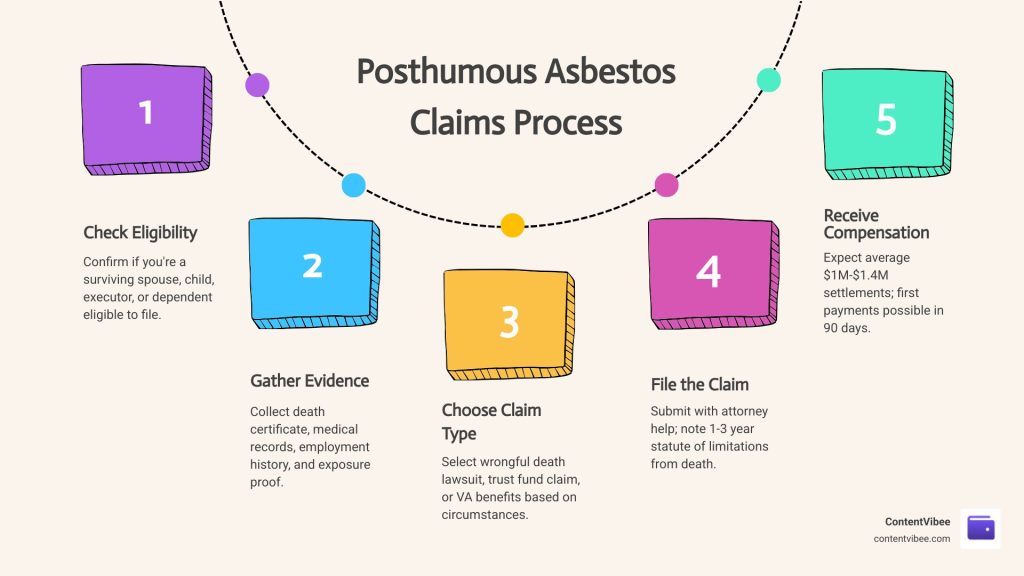
Navigating asbestos claims after death: Eligibility and Options

When we talk about asbestos claims after death, we are essentially looking at how to hold negligent companies accountable for the harm they caused. For decades, manufacturers used asbestos in everything from insulation to brake pads, even though they knew it caused fatal diseases like mesothelioma.
To help you understand the landscape, here is a comparison of the two primary legal routes:
Who is Eligible to File asbestos claims after death?
Eligibility can feel like a maze, but it generally follows state probate and wrongful death laws. In Virginia, for example, a court-appointed personal representative (often called an executor) must typically file the claim on behalf of the estate.
Generally, the following people are eligible to benefit from a claim:
- Surviving Spouses: Usually have the first right to file and receive compensation.
- Children and Stepchildren: Both minor and adult children can often recover damages for the loss of parental guidance and financial support.
- Estate Executors: If your loved one had a will, the person named as executor manages the legal process.
- Financial Dependents: In some cases, anyone who can prove they were financially dependent on the deceased may be eligible.
If your loved one already had a personal injury lawsuit in progress when they passed away, don’t worry—the case doesn’t die with them. We can “convert” that existing lawsuit into a wrongful death claim, allowing the estate to continue seeking the compensation your family deserves.
Types of Compensation: Lawsuits, Trust Funds, and VA Benefits
We want to ensure families maximize their recovery by looking at every available source. It’s not uncommon to file multiple types of claims simultaneously.
- Asbestos Trust Funds: There is currently over $30 billion set aside in dozens of trusts. These were created by companies that filed for bankruptcy to avoid endless litigation but were forced by courts to set money aside for future victims. These claims are often processed quickly because you don’t have to “sue” in the traditional sense.
- Wrongful Death Lawsuits: These are filed against companies that are still in business. While they take longer, the payouts are typically higher, with settlements often ranging from $1 million to $2 million. In 2024, trial verdicts for these cases averaged a staggering $20.7 million.
- VA Survivor Benefits: Since 1 in 3 mesothelioma patients is a veteran, this is a vital resource. For a married veteran who died of service-related mesothelioma, the VA may award survivors Dependency and Indemnity Compensation (DIC), which can be around $4,158.17 per month. There are also burial benefits of up to $2,000 available.
For more details on how these figures are calculated, you can explore how to file an asbestos claim after death
Understanding the Statute of Limitations for asbestos claims after death
Time is of the essence. Every state has a “statute of limitations,” which is a strict deadline for filing a claim. If you miss this window, you lose your right to seek compensation forever.
In most jurisdictions, the clock starts on the date of death, not the date of original exposure. Most states, including Virginia, typically allow 1 to 3 years to file. However, because asbestos law is complex, the “discovery rule” might apply, potentially extending the deadline if the cause of death wasn’t immediately known to be asbestos-related.
We always recommend starting the process as soon as possible. Gathering decades-old employment records takes time, and you don’t want to be rushed as the deadline approaches. You can find more specific guidance on these timelines at steps to file an asbestos claim after death.
The Step-by-Step Process to Secure Compensation

Filing asbestos claims after death might seem like a mountain of paperwork, but with the right specialized attorney, the heavy lifting is done for you. Most families find the process much easier than they expected because national law firms have proprietary databases of job sites and asbestos products used dating back to the 1930s.
The typical steps include:
- Free Case Evaluation: A specialized lawyer reviews your loved one’s work and medical history to see if you have a case.
- Evidence Gathering: This is the “detective” phase where we prove exposure.
- Filing the Claim: Your legal team submits paperwork to trust funds or files a lawsuit in the most favorable court.
- Discovery and Negotiation: Attorneys for both sides exchange information. Most cases settle out of court during this phase.
- Receiving Payouts: Once a settlement is reached, funds are distributed to the family or estate.
Essential Evidence and Documentation for Your Claim
To build a winning case, we need to connect the dots between your loved one’s illness and the specific products they were exposed to. This requires specific documentation:
- Medical Records: Documentation of a mesothelioma or lung cancer diagnosis.
- Death Certificate: To confirm the date and cause of death.
- Employment History: A list of job titles, dates, and locations. Union records or military service records (like the DD-214) are incredibly helpful.
- Co-worker Testimony: Statements from people who worked with your loved one can be the strongest evidence of asbestos presence on a job site.
- Product Identification: Identifying specific brands of insulation, gaskets, or talc powder used.
Because of the 20-to-60-year latency period, we often have to reconstruct a history from the 1970s or 80s. Specialized firms use their databases to match your loved one’s employer with known asbestos-containing materials used at that site. You can use this Realistic Settlement Calculator to get an idea of how these factors influence potential awards.
Payout Timelines and Average Settlement Amounts
We know that for many families, the financial need is urgent. While a full lawsuit can take a year or more, many families start receiving their first checks from trust funds within 90 days.
Here is what the data tells us about compensation in May 2026:
- Average Settlements: Between $1 million and $1.4 million.
- Trial Verdicts: Can be much higher, with 2024 averages around $20.7 million, though trials carry more risk.
- Trust Fund Payouts: These vary but often exceed $125,000 per claim, and a victim may be eligible for payouts from multiple trusts.
One piece of good news: Settlements from asbestos wrongful death claims are generally not taxable by the IRS. Because the money is considered “compensatory” for physical injury or sickness, it typically does not count as income. This allows your family to keep the full amount to cover medical debts, mortgages, or future education for children.
For a broader look at how different injuries are valued, you might find the Personal Injury Settlement Calculator helpful for comparison.
Conclusion: Securing Your Family’s Financial Future
At ContentVibee, we believe that holding negligent corporations accountable is about more than just money—it’s about justice for a life cut short. Filing asbestos claims after death ensures that the companies that chose profits over people are held responsible for the legacy they left behind.
The compensation recovered can provide your family with much-needed financial peace. Whether it’s paying off the medical bills accumulated during a loved one’s final months or ensuring a spouse can stay in their home, these funds are a vital resource.
If you are ready to take the next step, we recommend consulting with a specialized mesothelioma attorney who works on a contingency basis. This means they only get paid if you win, removing any financial risk to your family during an already difficult time.
For those looking to manage their family’s long-term assets or navigate the complexities of an estate following a settlement, we invite you to explore more info about real estate resources to help secure your financial future.
For further reading on your legal rights, you can also consult these expert resources: